How a snake-proof fence works
Five rules decide whether a snake fence works: mesh size, height, a buried bottom, sealed gates and drains, and a clear strip along the line.
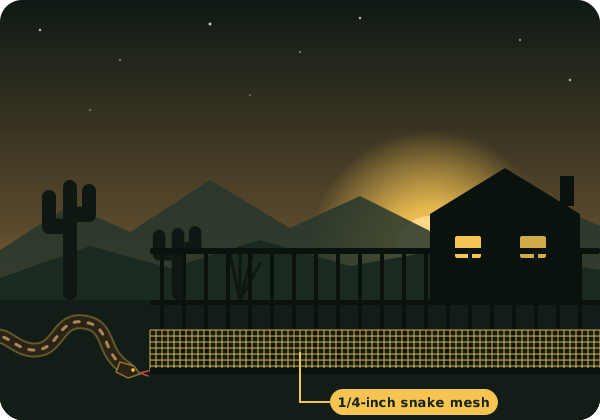
Short answer: A snake-proof fence uses metal mesh with openings of 1/4 inch or smaller, stands about 30 to 36 inches above the ground, has its bottom edge buried a few inches, and closes every gate and drain to the same 1/4 inch. Miss any one and snakes find it.
Key facts
- Use heavy galvanized mesh with 1/4-inch openings, about 36 inches wide, buried at least 6 inches, slanted outward about 30 degrees. [1]
- Baby rattlesnakes can crawl through gaps of about 1/3 inch and easily get through 1/2-inch mesh. [2]
- Cut tall vegetation along the fence so snakes can't climb over it. [1]
The five rules
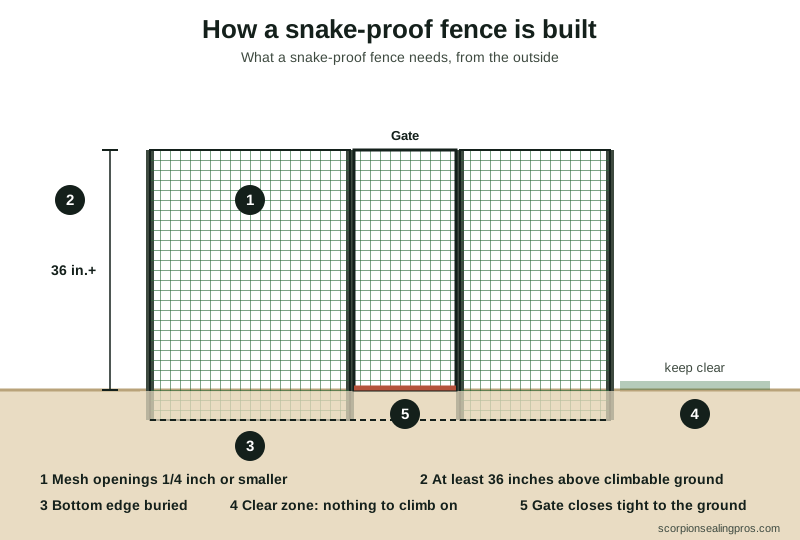
- Mesh 1/4 inch or smaller. Galvanized or vinyl-coated steel hardware cloth. Half-inch mesh stops adults but lets young snakes through.
- Tall enough. About 30 to 36 inches above grade. Many installers go 36 inches above the nearest thing a snake could climb, like a planter, step or rock.
- Buried bottom. The lower edge goes into the ground, often 4 to 6 inches, or is sealed to a concrete footing, so snakes can't push under.
- Gates and drains sealed. The bottom, hinge side and latch side of each gate close to 1/4 inch. Drains and wall openings get mesh that lets water through.
- A clear strip. Keep plants, firewood and debris off the fence line. Vegetation against the mesh is a ladder.
Fence types it works with
| Existing fence | What the installer adds |
|---|---|
| Wrought iron or view fence | Mesh along the lower 30 to 36 inches, fastened to the bars |
| Block or stone wall | Sealing of gaps at the base, drains and gates; mesh across low spots |
| Wood privacy fence | Mesh along the base, buried, plus gaps between boards near the ground sealed |
| Chain link | Mesh over the lower section; chain link alone is far too open |
| Open land, no fence | A new mesh barrier on posts around the area you want protected |
What it won't do
A fence protects the area inside it. It won't clear snakes already inside, and it won't stop one that rides in on a delivery or comes through an open door. After it goes up, walk the yard, remove hiding spots and keep rodents down so snakes have less reason to come close.
Next: /snake-fence-cost/, /snake-fence-installation/, /snake-fence-gates-drains/, /do-snake-fences-work/, /electric-snake-fence/.
Sources
Get a free snake fence quote
Tell us about your property. We send it to one verified local installer, never a list. Free, no obligation.
✓ 1 verified installer, not 5 · ✓ Free · ✓ No obligation
Common questions
How tall should a snake fence be?
About 30 to 36 inches above the ground, and 36 inches above anything a snake could climb nearby. Extension guidance uses mesh 36 inches wide with about 6 inches buried.
What size mesh keeps snakes out?
1/4 inch or smaller. Half-inch mesh stops adult snakes but lets young rattlesnakes through.
Can snakes climb a snake fence?
Smooth mesh slanted slightly outward is hard to climb. Plants, rocks or furniture against the fence give snakes a way over, so keep a clear strip.