Home / Snake fencing / Texas / Snake fencing in San Antonio
Local guide · Texas
Snake fencing in San Antonio
San Antonio sits where the Hill Country meets the brush country, so its yards can see all four of Texas's venomous snakes.
- Free quotes
- Local installers
- No obligation
Get free snake fencing quotes
Tell us about your yard. We'll connect you with up to three local installers. Free, no obligation.
Snake in your yard right now? Keep people and pets away, and don't try to kill or move it. Call a snake removal service or animal control. If someone is bitten, call 911. What to do now
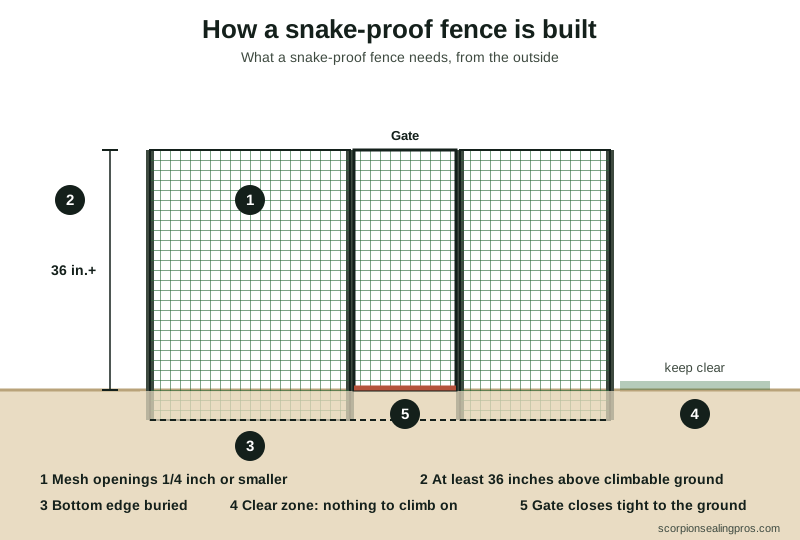
Short answer: A San Antonio snake fence is 1/4-inch mesh along the bottom of your fence, buried or sealed to rock, with gates closed off and beds and leaf litter cleared from the line. Small snakes like coral snakes are why the 1/4-inch size matters.
Installer coverage: We're signing one verified installer for each part of this area. Send a request and we'll tell you honestly whether one covers your address. We never sell your request to a list of companies.
Key facts
- Four venomous snakes can be found in San Antonio: the western diamondback rattlesnake, broad-banded copperhead, Texas coral snake and cottonmouth. [1]
- The western diamondback is the rattlesnake people see most around Bexar County. Black-tailed rattlesnakes are more common farther west but also turn up in Bexar County. [2]
- The Texas coral snake is on the Alamo Area Master Naturalists' list of the most common snakes in Bexar County. [3]
- Copperheads turn up in woodlands and grasslands. Cottonmouths prefer water. [4]
- September is when the snake population is at its highest, because that's when most snakes hatch or are born. [5]
- Texas has no statewide license for general construction. Some cities require registration or permits. [6]
Where snakes get into San Antonio yards
- The Hill Country edge. North and northwest neighborhoods toward Boerne and Helotes sit on limestone and cedar brush, prime rattlesnake country.
- Creeks and greenways. Lots backing onto creeks, drainage channels and greenbelts are where cottonmouths and copperheads come from.
- Under the privacy fence. Gaps open under wood pickets and at low spots, and rock makes it hard to bury a fence bottom.
- Beds and leaf litter. Mulch, leaf litter and dense beds against the fence give coral snakes and copperheads cover.
What the fence needs here
- 1/4-inch galvanized or vinyl-coated mesh. Coral snakes are thin, so gap size matters as much as height.
- The bottom buried several inches, or sealed to rock with mortar or anchors where you can't dig
- Every gate sealed on the bottom, hinge and latch sides
- A clear strip along the fence: beds, leaf litter and wood piles pulled back
When to book
Late winter, before snakes are active. Late summer into fall brings the most snakes, with young ones turning up in yards.[5]
Permits and HOAs
A snake fence is low and mostly attached to the fence you have, but check your city's rules and your HOA before work starts. Texas has no statewide contractor license, so ask for proof of insurance and look at past jobs.[6]
If a snake is in your yard now
Keep people and pets away and don't try to kill it. Call a snake removal service or animal control. If someone is bitten, call 911.
Before you get quotes
Take the 2-minute Readiness Check
- Count your gates, including RV and side gates
- Count the drain holes in your walls
- Pace off the fence line you want covered
- Take a few photos of gates, drains and the fence line. You can add them to the quote form
Check each quote against what a good quote includes. Estimate your yard with the cost estimator or the planner.
Areas we cover
Not on the list? We take requests from anywhere in Texas.
Install snake fencing in Texas?
We take homeowner requests from Texas. Claim it and get the first offer on every one. Pay only for leads you accept, and your first one is free.
Common questions
What venomous snakes live in San Antonio?
The western diamondback rattlesnake, broad-banded copperhead, Texas coral snake and cottonmouth.
Will a snake fence stop coral snakes?
Yes, if the mesh openings are 1/4 inch or smaller and the bottom is sealed. Coral snakes are thin, so gap size matters more than height.
When are the most snakes out in San Antonio?
Late summer into fall. September has the most snakes, because that's when most are born or hatch.
Sources
- Axios San Antonio: Springtime means more snake sightings in Texas (2023)
- San Antonio Express-News via PressReader: What to know as rattlesnakes begin getting active (2023)
- Alamo Area Master Naturalists: Snakes of Bexar County
- News 4 San Antonio: Five tips to avoid snake bites (Texas A&M AgriLife)
- San Antonio Zoo: Slithering through September
- PermitFlow: Texas contractor license guide
Guides
How High Should a Snake Fence Be?
At least 30 inches above the ground, and 36 inches is the common recommendation for large rattlesnakes.
How to Keep Copperheads Out of Your Yard
Remove their cover and food, then put a fine-mesh barrier around the areas where your family spends time.
Do Snake Repellents Work?
Not reliably. Sprays, granules and gadgets haven't been shown to keep snakes out. Barriers and habitat cleanup do.