Home / Snake fencing / Texas / Snake fencing in Dallas–Fort Worth
Local guide · Texas
Snake fencing in Dallas–Fort Worth
In the Metroplex the snake to plan around is the copperhead, and it gets in under wood privacy fences.
- Free quotes
- Local installers
- No obligation
Get free snake fencing quotes
Tell us about your yard. We'll connect you with up to three local installers. Free, no obligation.
Snake in your yard right now? Keep people and pets away, and don't try to kill or move it. Call a snake removal service or animal control. If someone is bitten, call 911. What to do now
Short answer: A DFW snake fence is 1/4-inch mesh fastened along the bottom of your privacy fence and buried several inches, with gates sealed and leaf litter cleared from the line. Homes backing onto creeks, greenbelts and woods need it most.
Installer coverage: We're signing one verified installer for each part of this area. Send a request and we'll tell you honestly whether one covers your address. We never sell your request to a list of companies.
Key facts
- Copperheads are the venomous snake DFW herpetologists are asked to identify and remove most often. [9]
- Copperheads cause more bites in North Texas than any other snake. [1]
- Copperheads blend into leaf litter and turn up in woodlands and grasslands. Cottonmouths stay near water: creeks, ponds and springs. [2]
- Southern copperheads live in wooded lowlands and river bottoms, and sometimes in wooded suburbs. [3]
- The venomous snakes to watch for in North Texas are copperheads, rattlesnakes, cottonmouths and coral snakes. [4]
- North Texas sits on expansive clay that shrinks as it dries out in drought and heat, so the ground moves around anything built on it. [5]
- In Dallas, a fence permit is needed for fences over 4 feet in a front yard or over 6 feet anywhere else. [6]
- Texas has no statewide license for general construction. Some cities require contractor registration or permits. [7]
Where DFW snakes get in
- Under the privacy fence. Wood picket fences rarely meet the ground evenly. Gaps open under pickets and at low spots, and they grow as the clay shrinks in summer.
- Gates. The gap under the gate, and the gaps at the hinge and latch sides.
- Creeks and greenbelts. Lots that back onto a creek, greenbelt, pond or woods are where copperheads and cottonmouths come from.
- Cover inside the yard. Leaf litter, firewood, landscape timbers and thick ground cover along the fence give copperheads somewhere to hide once they're in.
What the fence needs here
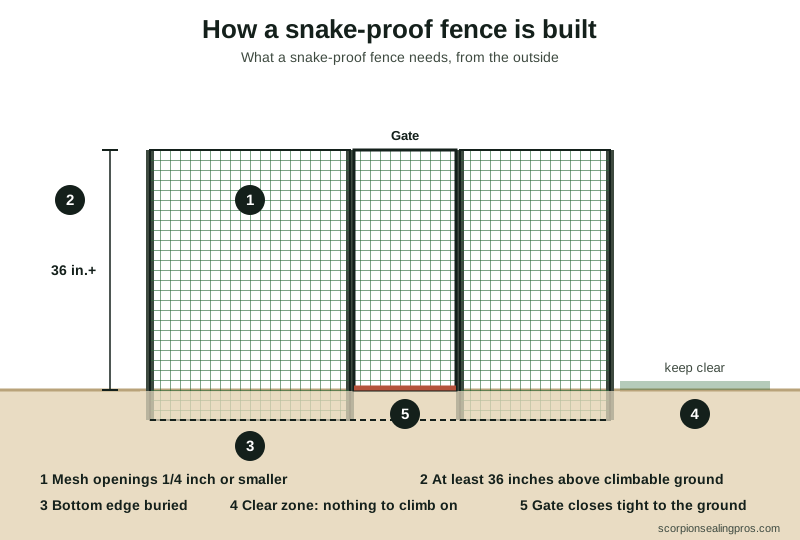
- 1/4-inch galvanized or vinyl-coated mesh along the bottom of the privacy fence, about 30 to 36 inches tall
- The bottom edge buried several inches, so it still reaches the ground when the clay shrinks
- Mesh on the side facing out, fastened to the posts and rails so it doesn't rot with the pickets
- Every gate sealed on the bottom, hinge and latch sides
- A clear strip along the fence line, with leaves, wood and ground cover pulled back
Clay soil
The clay under the Metroplex shrinks in summer drought and swells after rain.[5] A fence bottom that touches the ground in April can hang over a gap in August. Ask installers how deep they bury the bottom, and walk the line after the first long dry spell.
When to book
Late winter. Snakes come out as spring warms up, and copperheads give birth in late summer and early fall, so young snakes show up in yards from August into October. If your yard backs onto a creek or woods, have the fence done before then.
Permits and HOAs
A snake fence is low, usually 30 to 36 inches, and is mostly attached to a fence you already have. Still, check your city's rules,[6] especially on a lot near a creek or in a floodplain, and get HOA approval before work starts. Cities across the Metroplex set their own rules, so a good installer will know the ones where you live.
If a snake is in your yard now
Keep people and pets away and don't try to kill it. A gentle spray from a hose at a distance often moves it along. If it stays, call wildlife control or the Dallas–Fort Worth Herpetological Society.[8] If someone is bitten, call 911.
Before you get quotes
Take the 2-minute Readiness Check
- Count your gates, including RV and side gates
- Count the drain holes in your walls
- Pace off the fence line you want covered
- Take a few photos of gates, drains and the fence line. You can add them to the quote form
Check each quote against what a good quote includes. Estimate your yard with the cost estimator or the planner.
Areas we cover
Not on the list? We take requests from anywhere in Texas.
Install snake fencing in Texas?
We take homeowner requests from Texas. Claim it and get the first offer on every one. Pay only for leads you accept, and your first one is free.
Common questions
What's the most common venomous snake in Dallas–Fort Worth?
The copperhead. It causes more bites in North Texas than any other snake.
Will a snake fence work with my wood privacy fence?
Yes. Installers fasten 1/4-inch mesh along the bottom of the fence on the side facing out, bury the bottom edge, and seal the gates.
Do I need a permit for a snake fence in Dallas?
Dallas requires a fence permit over 4 feet in a front yard or 6 feet elsewhere, and a snake fence is usually 30 to 36 inches, but check your city's rules and your HOA first.
When are baby copperheads born?
Late summer and early fall, usually August into early October, so that's when young copperheads turn up in yards.
Sources
- NBC DFW: Snakes starting to come out in North Texas (citing Texas A&M AgriLife Extension)
- Texas A&M AgriLife: Five ways to prevent negative encounters with snakes this spring (2026)
- Texas Parks and Wildlife: Southern copperhead
- CBS Texas: Warmer weather brings snakes out (Texas A&M AgriLife)
- Dallas Morning News: How excessive, prolonged heat affects homes in North Texas (2023)
- City of Dallas: Fence permit checklist
- PermitFlow: Texas contractor license guide
- University of Texas at Arlington: Welcome to snake season (2022)
- WFAA: Experts warn of copperhead encounters as hospitals see more bites
Guides
How High Should a Snake Fence Be?
At least 30 inches above the ground, and 36 inches is the common recommendation for large rattlesnakes.
How to Keep Copperheads Out of Your Yard
Remove their cover and food, then put a fine-mesh barrier around the areas where your family spends time.
Do Snake Repellents Work?
Not reliably. Sprays, granules and gadgets haven't been shown to keep snakes out. Barriers and habitat cleanup do.